Along with other inquirers, I’ve written in these pages about the “do it yourself” nature of many of our spiritual or religious journeys. I’ve reflected on the language we use to shape our beliefs and wondered cynically whether those beliefs might actually be merely aspects of our own personalities. But now I want to look at the actual starting points for our beliefs. That is, no matter how self-made our faith may feel, I’ll propose that we were shaped by our family’s beliefs, the culture that surrounded us, the religious matrix that formed the literature we read, the houses of worship in our neighborhoods, and the prevailing hegemony of whatever religion was embedded in our environment. We may not want to look back at these homely origins, as we shop the infinite marketplace of religious ideas. But if we want our faith to be authentic and powerful, I believe it’s worthwhile to name and claim the home we left. And to ensure we left nothing valuable behind.
The original matrix for my particular worldview was laid out in the stretching suburbs of American Christendom. I grew up in a segregated southern town with only one Jewish family in residence at the time and a significant but hidden minority population. In this conservative town, my parents were private, secular, and progressive. They tried to protect us from the aggressive proselytizing of the other children by commuting 45 minutes each way to the one truly progressive church in the area. In addition to those relentlessly tolerant teachings, I found further support in the voices of my literary mentors: L. Frank Baum, Louisa May Alcott, Charlotte Bronte, and, heaven help me, Martha Finley, who wrote the luridly sentimental Elsie Dinsmore series that both fascinated and horrified me. As I grew up, I embraced the “do-it-yourself” nature of liberal theology: eccentric, questing, freethinking, non-traditional, and contemptuous of anything dogmatic or fundamentalist.
“My dogma just got run over by my karma.” Remember that?
I don’t need to go over every agonizing turning point in my spiritual journey, because that’s boring. It’s unique, yes; but it’s not special. Everyone has an origin story.
Your matrix will, of course, be particular to you. And if you are truly a seeker, you will probably examine that matrix, discard what is unhealthy about it, strip it down for parts. But when you do that, you may discover that some tracery of your cradle faith remains: half-remembered language; music once heard but now distant; moral teachings whose origin you cannot identify. Ideas that took root before you were seven, the magic age for instilling a belief system, will stubbornly remain. You know this because you see it in others, right? I believe it’s true for almost all of us.
“Give me a child until he is 7 and I will show you the man.”
This aphorism was attributed to Aristotle and then plagiarized, with all good intentions, by St. Francis Xavier in the 16th century. (They don’t say what it takes to form the woman, of course. I want to say it’s a little more complex, but that’s my bias.) Language, too, is overwhelmingly learned during roughly the same years of early childhood, along with good manners and riding a bicycle.

Choose your metaphor — there are plenty
Spiritual “seekers” may spend years or decades wandering about in the exotic foyers of all the other religious constructs, philosophical frameworks, or spiritual practices besides their cradle faith. Oh, it’s glorious out there, in the metaphysical heights of Buddhism; the sorceror’s world of Carlos Castenada, the rich marriages of flesh and spirit in the godheads of Hinduism; the stern submission of Islam! We seekers yearn to discover the Atman, or the Buddha or the Tao, whatever we might think they are, from a book we bought on Amazon, or a weekend retreat in the desert. And then we hear about achieving satori, and oh, perhaps we did achieve satori, that one night, remember? When we trustingly consumed a hallucinogen that kept us high for most of the weekend?
Sampling the infinite Varieties of Religious Experience is intoxicating, addictive. We might well have started with William James, of course, and hopefully we found James Fowler’s classic Stages of Faith as a developmental guide. But then, our life journeys may have brought us who-knows-where. Feel free to insert here your memory of that guru, or that seminar, or that new church or synagogue or temple, or that teacher you found along the way who took you far, far away from your own American roots into the exotic realms of those Others.
Perhaps you have been a spiritual bag lady, like me — going about collecting the ideas others have discarded, remnants of their childhood faith, or of their incomplete conversion, or of their shattered heart when it flew into the unexpected hard places that challenge any religion we might follow. I don’t knock that process at all. The world is marvelous and varied, and it’s a shame to remain locked in the cells of our original thinking.
Still, when you are busy cleaning house, and freeing yourself from all the dysfunction you think you know about your first religion, remember that, failing a lobotomy, you remain influenced by those core beliefs. And for many dissenters and seekers and survivors of bad religion, it can be unnerving to realize that there almost every area of your heart, mind, or soul was influenced in some way by the world in which you came up.
Parts, puzzles, questions
That’s why I recommend asking the question the astronauts asked when the Apollo 13 space flight was in deadly danger, due to malfunctions they weren’t sure they could fix. Captured in the film was a dramatic moment that I hope actually happened, because I remember it to this day. The captain assembles the whole crew, explains their dire predicament, and asks them:
“What’s good about the spacecraft?”
The crew members then all go looking with that question in mind — seeking whatever was still working; what could be re-purposed; what could be used to replace what was broken. They bring all of their resources from every part of the craft and dump them on a table, and then the saving work begins.
I’ve used this rubric many times in my life, when things seemed out of control, or descending into a death spiral, or otherwise plainly doomed. What’s good about this spacecraft, I will ask—by which I mean this body, this mind, its community, its possessions, its resources, its will.
This trick is just a quick way to change one’s focus. It forces an assessment that is rooted in reality and not imagined doom. Or even real doom. Even if we feel doomed, there might be some strength hidden somewhere that we haven’t had to use recently; some help we might seek; some practice we have abandoned but might need now; or any small step we can take away from the precipice.

Mountain high
But eventually, the seeker begins to see — delightedly or grudgingly — one of two metaphors. There’s the popular trope that All Religious Paths Will Reach the Top of the Mountain. I’m not so sure that’s true. There’s no guarantee you will “reach the top.” You could just as easily fall off a cliff, slide to the bottom, enter a box canyon and get hopelessly lost, or simply go round and round the mountain, halfway up, and never get anywhere.
River deep
There’s another metaphor that seems more reliable to me. Deep below the surface of all our souls runs a massive underground water table of cosmic truth and sustenance, fed by hidden springs and bubbling up in wild places all over. Faith traditions are shaped by the landscape in which they emerge, and the structures built around those springs, but the essence is mostly the same. And daring mystics might even sink their own wells — go straight to the source and drink deep.
As I am internalizing this metaphor, it begins to seem superfluous to keep flying about, trying to see all the places where that underground river of soul shows up. I begin to see that the Infinite Cosmos is great enough and varied enough to encompass and bless (if that is your language) all the sacred places, holy icons, divine practices, and human beliefs that there are. I’m trying to dwell and revel in the deep waters that were hidden under the house I was born in.

Our earliest memories generally last the longest, as we know. I observed this tendency first-hand, when I made a pastoral call on a woman in her 80s with severe dementia. The debility had gradually erased great swathes of her mature life and memories, leaving all but her earliest recollections. She had learned fluent English after emigrating from Germany at the age of 10; now, though, she had forgotten English almost entirely. The only utterances she could make were to sing, in German, scraps of the hymns and songs she had sung as a child. Singing or hearing those songs were the only remaining sources of real joy in her life. I recall how her face lit up. That language; those songs; those mysteries, were the essence of her faith that remained.
It’s the memory of this woman that makes me certain that it is not a mistake to revisit one’s original faith. In fact, I wonder: if we spent the same time and energy exploring that faith as we did looking for another, better one, wouldn’t we find there were depths there that we had never noticed? Mystery. Paradox. Poetry. Love.
The great religions offer different ways to explore the lifelong, central mystery of our existence. That mystery doesn’t just unfold neatly in your hand, like badly folded origami; moreover, finding one “answer” usually means you have to discard three others. Finally, after all the running around looking for the perfect faith, perhaps it is better to return to our OG faith for the deepest insight, the most internalized means of figuring out the world.

“…If I ever go looking for my heart’s desire again, I won’t look any further than my own back yard; because if it isn’t there, I never really lost it to begin with. Is that it?”
“That’s it.”
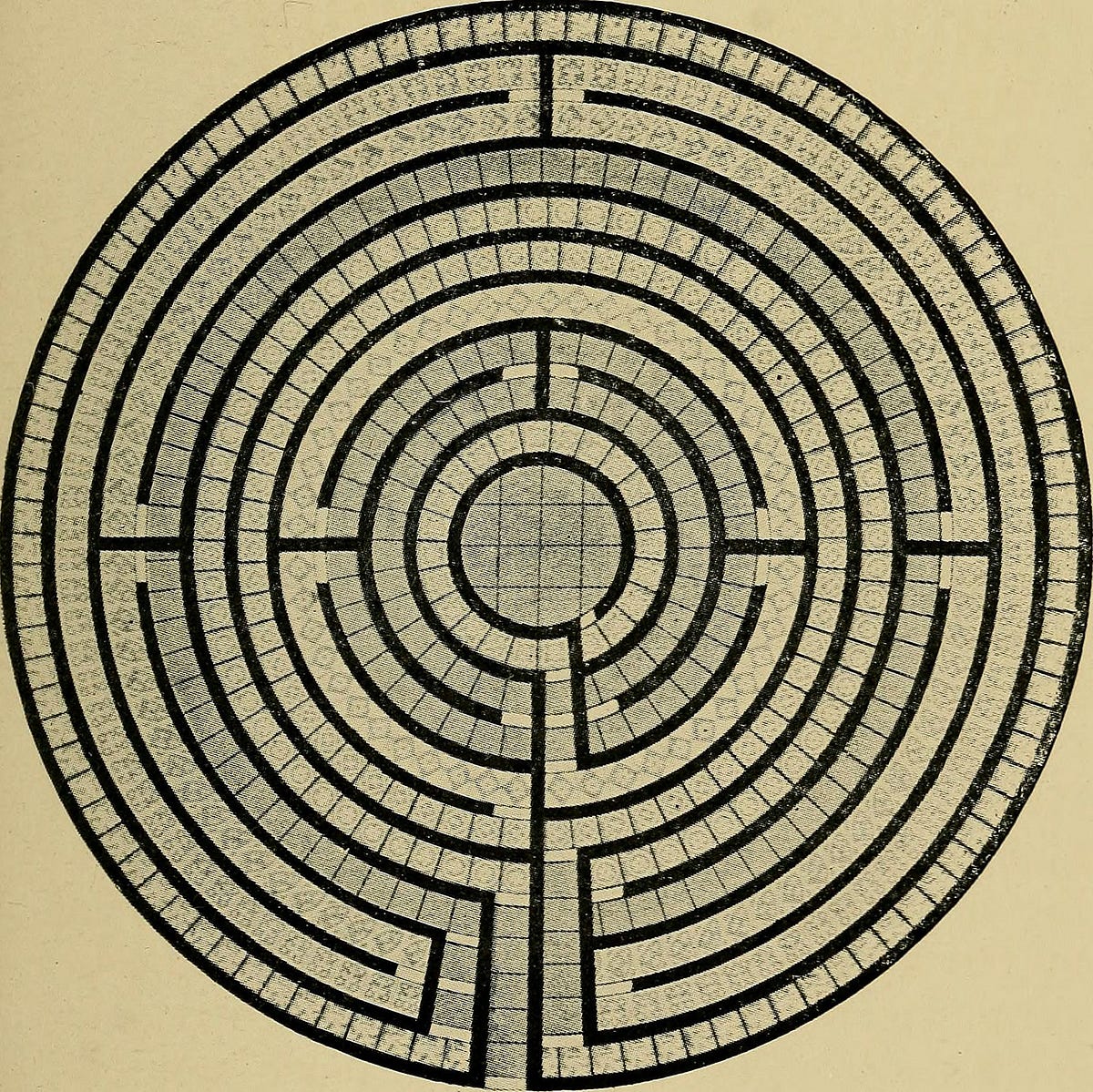
But a spiritual journey isn’t just a remake of Dorothy’s trip to Oz — though for all we know that’s what L. Frank Baum had in mind. Rather, it is perhaps more like a labyrinth. A labyrinth is not a maze — it begins in one spot and allows you to walk through it to the center. I walked a labyrinth once, and noted after a time that I found myself quite near the place I had entered. Quite near, but not exactly at the entrance, for I had walked all that way.
And I still had all that way to go.
 Rev Dr Sparky on Real/igion
Leave a comment