Three secret steps to be as old as you want to be.
I’ve watched with compassion as millennials and others struggle to learn “adulting” skills, and I dimly recall when I, too, was learning those skills. The struggle has faded in memory, along with the absurd dissipation, unfortunate liaisons, wild travels, and extravagant decisions of the times. I forget how, but eventually, I learned to hold a day job, juggle money and debt just well enough, move out of my parents’ home, “buy” a house (aka assume a mortgage), and so on. I became an adult in the real world.
But the so-called “real world” is an illusion. It entices us like an exclusive night club, and we learn the secret words and gestures that get us past the bouncer.

So we enter the “real world” — the economy; the culture; the electorate, etc. — and start adulting like crazy. But that “real world” we think we’re in is simply a construct, complete with light shows and loud music and substances to make it palatable. If we start thinking it’s more than that, it can suck the life out of us. But if we can stand the noise and chaos, and not get trampled in the rush to the bar, we may eventually get to escape by the back door and return to the really real world.
Then we’ll be done adulting and we can start olding
I call it “olding” because I want to actively become a certain kind of old. I want to be old like Stonehenge; old like dirt; old like the simplest particle that cannot be added to or subtracted from.

Rev Dr Sparky’s secrets for hard-core olding
Proactively olding means making changes, small and large, that I never anticipated and was never told about. And I’m not talking about how to manage your investments or sign an advanced directive or any of that nonsense. That’s all just left-over adulting, anyway; anyone can tell you that. My list includes the simple secrets of how to get past that to the fun stuff.
1. First, come to terms with your hair.
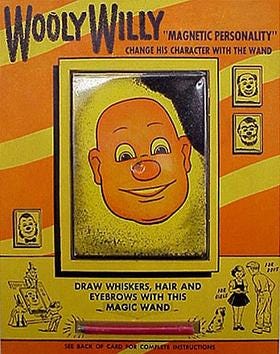
Does anyone remember Wooly Willy, the popular toy from the mid-20th? Willy is a face on cardboard, and his “hair” consists of iron filings under a plastic screen. Through the miracle of science, you can move Willy’s hair all around with a magnetic wand — from head, to chin, to ears, and back again.
Everyone who is past maturity eventually becomes Willy, and Nature takes the wand. She takes the hair from our heads, sometimes removing it altogether and sometimes just thinning and grizzling and drying it out.
And then, Nature moves that hair to places it’s never been before. Ears. Moles. Chins. (Don’t act like you don’t know what I’m talking about, cupcake.) We cannot talk Nature out of this, so we need to clean up our act. No one without hair in their ears wants to see hair in your ears.
It’s a matter of survival, really. Oldness changes how people are perceived. On a 25-year-old, a bedhead may look sexy. On an olding person, it looks like a troubling sign of depression or dementia (“I’m worried about Aunt Claire! She doesn’t even comb her hair anymore!”). On a 25-year-old, a wild mane can be a rock-star, Jesus look. Later, it may read more as a dirty-old-man-look.
Time to accept what our hair is really doing and deal with it. Now, I just want to stay clean and look as if I can manage my own affairs, so that people will leave me the hell alone.

And the rest of the body
And what goes for the hair goes for the whole body, too. Olding means radical acceptance of our whole body, warts and all. (I don’t have any warts, I hasten to add. It’s just a figure of speech.) I have recently realized that I will never, ever, ever have the lean, toned, Jamie Lee Curtis sort of hardbody that has eluded me all my life.
Please don’t tell me, yes, I could. First of all, Jamie Lee Curtis is not a good example, since she is clearly either a mutant or an alien. Second, well, of course, I suppose I could have such a body. But I would need a montage to do it. You know — a movie montage, where months of grunting, sweating, painful training is compressed into about 45 seconds of imagery: ‘ target=”_blank”>me and a tough but loving coach yelling at me, and me all sweaty but determined, and then maybe me running up the steps of… oh, wait. That’s “Rocky.” That’s not me.
Others may still want to maximize their enjoyment of their bodies with violent exercise, surgery, yoga, whatever, all the way up to the full-montage miracle. Fine with me.
But radical olding requires that I finally make peace with this little meat puppet I’m living in, after all these years of criticizing its imperfections and resenting it when it hurts or breaks.
And that way, when it comes time to return it to the factory, we will be able to part friends.
2. Second, get your house in order.
I am sure that I cannot survive being old unless I drastically simplify my household. The most immediate reason is, of course, that I can no longer find anything. As memory dwindles, the amount of time it takes to find things grows exponentially. Tick-tock. Still can’t find that coupon.

Curate your collection (if that sounds better to you)
So my olding process has included a radical, transcendent housecleaning. It’s actually more than that — it’s a house-claiming: a way of remaking my habitat into a place where everything belongs, including me. It’s no accident that Marie Kondo’s mindful, nonjudgmental method of tidying up has struck a chord among Americans — or sometimes a nerve. We have been drowning in excess things for decades, and we have scarcely noticed that most of those things are turning into trash.
Adulting means buying things wisely, but olding means finally tending to the things you actually have. To be sure, “tidying up” appears to be an activity for the economically privileged. When middle class folks tidy up, they often discover clothing with the tags still on; supplies they bought twice because they didn’t know they already had them; endless items they cannot even remember getting. Be ready to face that embarrassment head on.
But it’s arrogant to believe that poor people can’t or won’t curate their things or reflect on which purchases give the most bang for their buck. Even on my newly “fixed” income, I still strive to live by the famous precept of the designer William Morris:
“Have nothing in your house that you do not know to be useful, or believe to be beautiful.”

Lighten the load, literally and figuratively
As I cleaned and de-cluttered my house, I even realized I had to simplify things like my handbag. I was getting embarrassed at how long I spent fumbling in my favorite leather tote as I did my errands. I was tired of the relentless interior monologue:
“Um… here are my sunglasses, but where are my keys? DO I have my phone? Well, at least I found my wallet, but now I can’t get the… dammit… why do they always hand you your change ON TOP of the bills, where they just slide around and you need two hands to put it away? All right. Now where did I park? I hate the world.”
Olding means you take command of your person and your space, whether you end up a minimalist, a maximalist, or just someone with tidy closets. It’s up to you how you’re going to live from now on. I’m merely reminding you how much time and energy it takes to own, store, maintain, repair, and most of all, find all that stuff. That’s not the way I want to spend my time, so the less I have, the more I enjoy what I do have.

3. Finally, ditch your dreams.
There. I said it, and I’m not the first, so I think it might be good advice. It is time to kick those dreams to the curb. I don’t mean the real and rich workings of our unconscious minds — I mean the ambitions and drives and agendas that our culture encourages us to create.
From childhood, we are pushed to dream, to dream big, and then to relentlessly pursue not only our own dreams but the American dream. Too often, those “dreams” actually become cruel fantasies designed to keep us unhappy, unfulfilled consumers.
Not me. Not anymore.
Just as olding requires me to clean my physical house, I must clean up my mental house, too. Remnants of old dreams litter the place. Here are images of me taking a third curtain call at a distinguished repertory theater; over there is a 3-D model of the office of a tenured professor at a well-regarded small college. Further down the corridor is my imaginary seat at an innovative church renewal conference, and hidden in the corner, God help me, is the book signing table I hoped to sit at someday.
To be sure, following those dreams pushed me into learning and doing many delightful things. It also drove some terrible mistakes. But eventually, all of my efforts have come short of the constructs I had made, so they no longer “spark joy” by any measure. So I decided to throw them out. Maybe those “dreams” were useful once, but I don’t need them any more. I’m awake now.

Olding means awakening
In some ways, “following your dreams” is a poor way to plan a life. Why? Because you will never know when you have succeeded. You will never know when you have “lived your dream” until you wake from it.
Of course, if there’s really no real world, I may simply have “awakened” into yet another construct. Doesn’t matter. The point is not to let illusion ruin the actual moments we are living.
When I leave the dead dreams aside, I can better see what was actually happening during all those years. I learned, taught, forgot, and then re-learned, all manner of ideas. I met and loved many people, I endured suffering, and I fell into unexpected joy, too. I failed at realizing many dreams, over and over. But in the end, those dreams are dust, and I’m still here, so I win.
I’ve only begun to explore my newly-cleaned and re-organized body, house, and mind, and I’m still making lots of mistakes. But I’m still glad to be shaping the kind of old person I want to be.
Old enough to know better.
Old enough to know.
Old enough.

Want to know more? Read on for an update:
 Rev Dr Sparky on Real/igion
Leave a comment